I must apologise for my lack of posts in recent months. I’ve been unexpectedly busy recently with travelling, volunteering and Other Miscellaneous Activities, and it’s been difficult to find the time to write. What is more, I’ve also been very distracted by research for a project I’m undertaking which requires a lot of reading into a very different area of history, so I haven’t yet been able to shift my brain out of Nineteenth Century Arctic Naval Exploration Mode and into the mindset necessary for Henry discussion. I hope he doesn’t mind too much.
That being said, I do have a post about ableism in historical analysis of Henry in the works, so hopefully you should see that within the next few weeks. Until then I hope you are all having a lovely start to winter, and that those of you who celebrate Hanukkah or Christmas (or any other celebration) are enjoying the festive season. See you soon!
For several years now I have been endeavouring to get my hands on a book called Kingship and Masculinity in Late Medieval England by Katherine Lewis. It’s been sitting hopefully in my Amazon wishlist for so long I won’t be surprised if it arrives obscured beneath a clear inch of dust when I finally give in to temptation and pay the £30.99 necessary to sate my curiosity. The description on Amazon makes it that much harder to resist: ‘This book (…) also asks how far Henry V and Henry VI can be said to have understood the importance of personifying a particular brand of masculinity in their performance of kingship and of meeting the expectations of their subjects in this respect‘; and a little later, still more intriguingly, ‘Consideration is also given to Margaret of Anjou’s manipulation of ideologies of kingship and manhood in response to her husband’s incapacity, and the ramifications of this for perceptions of the relational gender identities which she and Henry VI embodied together‘. (If this interests you as much as it does me, you can find the Amazon listing here.)
This is essentially the topic I’m going to discuss here–though in far less detail and depth than Katherine Lewis I’m sure provides. I also want to briefly touch upon chastity and its significance in late medieval England, with a mind to comparing Henry VI’s adherence to virtue with the expected hypermasculinity of 15th century kings.
I hope you will forgive me if I become a little more speculative in this post than I have been in my previous publications. As with the vast majority of historical figures from this era–and monarchs in particular–there is a tragically small amount of contemporary material provided by Henry himself, meaning a lot of the discourse about aspects of his personality and character must inevitably come from those around him. Fortunately Henry’s coevals wrote enough about him that discussion of his temperament as a man, rather than as a king, is not entirely pointless; but even so, the waters become far murkier when delving into such sticky topics as the emotions of long-dead monarchs.
One of the figures who is often brought up when analysing the failures of Henry VI’s reign is, perhaps unsurprisingly, his father, Henry V. Henry V enjoyed a far shorter–and far more successful–reign than his son, spanning just nine years from 1413-1422. Of all the monarchs of medieval England, he is probably the most celebrated, and certainly one of the most well-known: his victories in France, particularly that at Agincourt in 1415, are still quite present in the public consciousness. It also helps that Shakespeare wrote a nice play about him.
The Moste Noble & Gloryus Kyng Bowle-Hedd
Henry V’s ascension to the throne followed a period of considerable unrest in England. Henry’s own father, Henry IV, had spent most of his fourteen-year reign attempting to suppress rebellions and assassination attempts following his deposition of the unpopular Richard II, who had succeeded to the throne in 1377 at just ten years old and spent the next twenty-two years dealing with revolts, uprisings and political crises. It must have seemed to both the nobility and the general populace that normality had returned at last when, in 1413, Henry V was crowned following his father’s death on the 20th of March and quickly proved himself to be, not just a king who could restore order to England, but one who could–and would–expand and conquer beyond the shores of the British Isles. Over the following years, Henry’s forces saw success throughout France: Harfleur and Agincourt in 1415, Lower Normandy and Rouen in 1417-20, Melun and Montereau-Fault-Yonne in 1420, and Dreux and Meaux from 1421-22. It was a period of staggering overseas success, and likely seemed even grander considering the social and political turmoil which had preceded it.
Upon Henry’s sudden death in 1421 during one of his French campaigns, the affairs in France passed to his brother, John Lancaster, 1st Duke of Bedford, and the crown passed to his only child, Henry of Windsor, who at the time was a mere nine months old. Just a day after his father’s death, Henry of Windsor became Henry VI of England. Six years later he was formally crowned at Westminster Abbey on the 6th of September 1429, and again as King of France at Notre Dame de Paris on the 16th of December 1431. At ten years old, Henry was now King of both England and France (at least in name); but it would be another six years before he began to involve himself in affairs of state.
The reason I bring up Henry V is to make the comparison between his very authoritative, domineering and warrior-like approach to kingship and that of his son. Henry VI could not have been further from his father in terms of kingly authority–something which was all too painfully obvious to the nobles of his court. A small selection of quotes I’ve compiled from books and websites over the years should give you an idea of the sort of king he turned out to be:
‘Gentle, pious and even saintly, he would have been far happier as a monk. Detesting violence and bloodshed, no man could have been less suited to late-medieval kingship. But he was as incapable of leading his country in peace as in war, for he had no understanding at all of politics of statecraft, and was a liability to the men who tried to govern for him.’ ~Desmond Seward, ‘A Brief History of the Hundred Years War’
‘As king, Henry was pious, indecisive, and easily-led, and of course later in life, he became severely mentally unstable. He was kind and generous to those he cared about (which did not help the dire financial situation of his government), giving away land and titles to his advisers. (…) Henry seems to have been a decent man, but completely unsuited for kingship. He allowed himself to be totally dominated by the power-hungry factions which surrounded him at court and was later powerless to stop the outbreak of bloody civil war.’ ~New World Encyclopedia
‘Some monarchs are powerful forces of nature, around whom all the events of their reign revolve. Henry VI was not one of those. Instead of being the focal point of his reign, he drifted with the ebb and flow of those surrounding him. Although Henry ruled the country, he could not even rule his own mind and would agree with the opinion of those around him.’ ~h2g2: Henry VI – The Reign of England’s Weakest King
‘He was a man of pure simplicity of mind, truthful almost to a fault. He never made a promise he did not keep, never knowingly did an injury to anyone. Rectitude and justice ruled his conduct in all public affairs.’ ~John Blacman, Henry’s confessor
‘In 1440, what could not be doubted was that Henry was seeking a very different form of kingship from that exercised by his father. Government had remained in stasis since 1422, the will of the dying Henry V maintaining its vice-like grip on the policy of his kinsmen and councillors. Warfare had been its defining characteristic. This was a course that Henry VI could no longer follow. Now that he had full authority over his two kingdoms and the support of a coterie of new advisers within his household, he was determined to pursue a policy of peace.’ ~Lauren Johnson, ‘Shadow King’
Although these modern and contemporary descriptions of Henry’s style of governance should not necessarily be taken at face value–John Blacman’s account in particular should be scrutinised as it was written to petition the Pope for Henry’s canonisation–there are some strong overarching themes which are consistent throughout. I find it especially interesting how Henry is repeatedly described as a good man regardless of his disastrous reign, appreciated for his sincerity and kind nature if not for his policies–which, in a way, must have made it far more difficult for criticism to be levied against him. A tyrannical king is easy to oppose; a misguided king who has his heart in the right place is not so much.
Henry’s youth was spent primarily in the company of his mother. Catherine of Valois was the youngest daughter of Charles VI of France and the queen consort of England from 1420-22, and following the death of Henry V was very present in her son’s upbringing. In fact, Henry’s youth was dominated by women, as Lauren Johnson’s Shadow King describes: ‘Catherine not only lived with Henry, she also kept a close watch on his household servants, and many of Henry’s attendants had existing connections to the queen. (…) His entourage of attendants was largely female.’
Whilst it should not be automatically assumed that Henry’s very female-led childhood had an impact on his approach to kingship, it is also worth considering the male figures Henry had in his life at this point. With the death of his father, the men Henry was exposed to were primarily friends or relations of the deceased king, in particular Henry Beaufort, Bishop of Winchester; John of Lancaster, Duke of Bedford; Humphrey, Duke of Gloucester; and Richard Beauchamp, Earl of Warwick.
It must be presumed that under the tutelage of these men who had, in some cases, fought by his father’s side and witnessed his conquests firsthand, Henry would have been constantly regaled with stories of Henry V and his great triumphs in France. He must have seemed a perfect hero to whom the young king could aspire–and it’s easy to imagine the weight of expectation which such ceaseless comparison would generate. This was a man Henry had never met, yet who lived on in his victories overseas and in the memories of those who now surrounded his son. The crushing burden of living up to Henry V’s memory presumably plagued Henry throughout his entire reign, especially as every mistake or blunder he made would inspire mutterings about what his father would have done. It would have been a tremendously difficult situation for any monarch to deal with, let alone a child with a predilection for peace.
Something I find very revealing is the ubiquity of ‘feminine’ traits in discussion of Henry VI’s characteristics. (I use gendered terms for want of a better way to describe them; it goes without saying that these are based on often outdated stereotypes, and in reality are exhibited by people of all genders.) His gentleness, kindness, introversion and generous nature are all heavily emphasised by contemporaries and historians alike, creating an oftentimes deliberately unflattering image of him as an absent-minded, childlike pushover entirely dominated by his more masculine wife.
Margaret of Anjou (who really deserves her own post, and will likely get one in the future) was wed to Henry in 1445 following the Treaty of Tours, a short-lived peace agreement between France and England. Both modern and contemporary sources are riddled with misogyny in their descriptions of Margaret, who is often described as a ‘she-wolf’ who would stop at nothing to protect the interests of her only son. Margaret did, in fact, take a much more active role in military proceedings than her husband: she was present at the Second Battle of St Albans in 1461, as well as the Battle of Tewkesbury in 1471, and lead the campaign of Lancastrian resistance during Edward IV’s first reign. This, and the fact that Henry was incapacitated by illness numerous times during their marriage, has led to a caricature of her as a ruthless, masculine woman who very much ‘wore the trousers’ in their relationship. Multiple times Margaret was left with a sickly husband and a young child to care for in the face of feuding political factions, so it is hardly surprising that after a while she learned that she needed to exert her own authority if she wished to keep her family safe–even though, sadly, her efforts would ultimately be in vain.
The marriage of Henry VI and Margaret of Anjou, 23 April 1445
Amongst the more prominent masculine traits of a medieval king are that of control over one’s wife, or women in general to some degree, and a healthy amount of virility. The purpose of a queen was, at its core, to provide the king with offspring to ensure the succession of his blood; and it was the responsibility of a king to make his necessary contribution. Henry, unfortunately, does not appear to have been at all keen on this duty. As well as his general kindness and generosity, Henry’s chastity and prudishness are mentioned repeatedly throughout medieval documentation. John Blacman writes, ‘He delighted in female society, and blamed that immodest dress, which left exposed the maternal parts of the neck. “Fie, fie, for shame!” he exclaimed, “forsooth ye be to blame.” (…) Where there are warm baths in which they say the men of that country customarily refresh and wash themselves, the King, looking in the baths, saw in them men wholly naked with every garment cast off. At which he was greatly displeased, and went away quickly, abhorring such nudity as a great offence.‘ Blacman also recalls an instance in which bare-breasted dancing girls appeared before him to entertain the court, at which the king stormed out of the room, saying he would ‘keep watch through hidden windows of his chamber, lest any foolish impertinence of women coming into the house should grow to a head, and cause the fall of any of his household‘. David Grummitt’s Henry VI further acknowledges his faithful devotion to Margaret: ‘Henry’s devotion was as apparent in his public life as it was in his personal piety. Blacman approved of his chastity, claiming he was never unfaithful to Queen Margaret and that he had even ‘made a covenant with his eyes that they should never look unchastely upon any woman’.‘
In a woman, these characteristics would have been seen as indicative of the greatest virtue; in a king, they were almost disastrous. Given how long ago Henry lived, and how little of his own writing survives, it’s almost impossible to tell whether he was chaste for religious reasons, celibate, or even asexual; but what is certain is that it took almost eight years for Henry and Margaret’s marriage to produce a child. Even then there was a great deal of speculation that Henry was not the father: rumours quickly spread that Edmund Beaufort, 2nd Duke of Somerset or James Butler, 5th Earl of Ormond had stepped in on account of the king’s inability to beget an heir. It has also been speculated that Margaret’s pregnancy may have contributed to Henry’s breakdown in August 1453: it’s possible he saw it as a moral failure given his firm adherence to his own chastity, even though, in a political sense, it was a godsend. This attitude was met with frustration and confusion from his contemporaries; as Katherine J Lewis in Holiness and Masculinity in the Middle Ages puts it, ‘he did not exhibit the appropriate levels of kingly heterosexuality: only one child after eight years of marriage and a strong suspicion that he had not been keen to consummate it at all‘.
An 18th century engraving of Edward of Westminster, the only child of Henry VI and Margaret of Anjou
Criticism of Henry’s masculinity has often been present in modern analysis of his rule, and it’s only in recent years that I’ve seen more sympathetic takes on his particular approach to kingship. (Once again I must recommend Lauren Johnson’s Shadow King, which I do almost daily in conversation and have been restraining myself from doing repeatedly in every post so far. Go and buy it! It’s the best.) As with all medieval history, it’s impossible to read too deeply into the few sources we have available without becoming wildly speculative; but I like to think about it nonetheless. Perhaps it’s only now we as a society have started to critique our own approach to gender expression that we’ve also begun to reconsider the way we read history and the characters within it.
Thank you very much for reading! Whilst researching this post I came across a fascinating essay called Defamation, Gender and Hierarchy in Late Medieval Yorkshire by Bronach C. Kane which, whilst not strictly relevant to the points I’ve been discussing in this post, is nevertheless a very informative read. You can have a look here if you’re interested.
One of the more commonly-touted opinions about Henry, which is ubiquitous in formal and informal discussion of him alike, is the suggestion that he was–to use a term I take deep issue with–‘simple’. Not only is this aspersion built on deeply ableist foundations which condemn him for his struggles with mental illness, it also has very little basis in fact.
I will more fully cover the ableism displayed in attitudes towards Henry in a future post, as I have a great deal to say on the subject and it’s something which is, in my opinion, not touched upon often enough; but I do wish to mention it briefly here, as it is very significant in respect of his educational pursuits. My thoughts on this can be fairly neatly summarised by Myself from the Past, speaking from my informal, not-officially-history-but-quite-a-lot-of-history-anyway blog:
(Transcription: ‘thinking about the fact that there is a surplus of evidence that henry vi was very educated and erudite both as a child and a man and was intensely interested in promoting education and scholarly pursuits yet is still presented as dull-witted and unintelligent owing in part to his lack of political and social savviness but also subtle ableism inspired by his life-long struggles with mental illness’.)
Since writing that extremely run-on sentence, I would say my opinions have changed somewhat: I would no longer call it ‘subtle ableism’, but rather ‘full-blown ableism’. As I said before, I will be making a more in-depth post about this topic in the future once I have had the time to marshal my thoughts into something comprehensive; but for now I want to instead discuss Henry’s involvement in education and the evidence to suggest that he was, in fact, not nearly as vacuous as he is made out to be.
(An interesting fact I discovered whilst doing some brief research for this post is that medicinal herbs were historically called ‘simples’. Gardenvisit.com has a nice little description: ‘Also known as a herb garden or a garden of simples, specialised medicinal gardens have been made at least since the Middle Ages, though plants were grown for medical purposes long before. A ‘simple’ is a herb used on its own in medical treatment’. This isn’t strictly relevant to Henry and his educational pursuits, but I thought it was a curious detail regardless, even if the word ‘simples’ has been somewhat spoiled for me by the meerkat on the telly.)
One of my favourite facts to spring upon people is that Eton was actually founded as a poor boys’ school, created to provide free education for deprived youths. Given that this was the early 15th century, the fact that it was a school for exclusively boys is entirely unsurprising–I’m sure I don’t need to go into why a school for girls of this calibre would have been rather unlikely–but what is surprising is the fact that that the King, not yet twenty years old, was already establishing himself firmly as a champion of education and learning. What an enormous contrast with Henry V, and indeed any of the preceding monarchs! Although previous kings had made their mark on academia, none had taken such a firm path, or done so at such a young age, as Henry VI. He was proving himself clearly as a different breed of king to his father: more a scholar than a warrior, more a monk than a king.
Eton College was founded in 1440. Henry himself laid the first stone, and indeed had an enormous amount of involvement in its development and construction alongside the master mason Reginald Ely. John Blacman, perhaps the most ubiquitous biographer of Henry VI, described how he ‘graced the laying of the foundation stones with his presence, and with great devotion offered his foundations to Almighty God’. In fact, the original documents detailing the plans for the college’s construction, as well as those for its sister college in Cambridge, still bear the marks of Henry’s hand. I find that absolutely wonderful. I have not yet seen those documents in person, but it is a great aspiration of mine!
(Above can be seen the statue of Henry which presides over Eton’s courtyard. It was sculpted in bronze by Francis Bird in 1718, and depicts Henry holding the orb and sceptre of office. I am particularly fond of this statue, partly because it’s one of very few extant statues of Henry, and partly because it actually seems to look a bit like him. Here is a slightly more revealing angle:
What a very dashing fellow! I am a particular fan of his trousers.)
Henry’s desire to be involved in the development of his colleges is undeniably admirable, and his commitment to his vision is commendable; but his perfectionism and persnickety attitude to minor details held up construction considerably. This came into play particularly with the building of the chapel of King’s College, which was begun along with the rest of the college in 1441 but not finished until 1515, a staggering seventy-four years later. A significant reason for this was Henry’s keenness for the chapel to be a grand landmark in its own right: having already established the foundations of Eton’s chapel, he now wanted to expand his scope and create something which would rival other holy buildings in England and the continent–which is saying something, as he already intended the nave of Eton’s chapel to be the longest in Europe, and hoped it would house religious relics including the Crown of Thorns and a section of the True Cross. Given the enormous significance of religion both in Henry’s life and in the culture of the 15th century, this does not come as a surprise. Construction at Eton was further impeded by Henry’s deposition in March 1461 after the Battle of Towton, and the school subsequently suffered significant cutbacks under Edward IV. (Great sibilance there.) A mistress of Edward, Jane Shore, supposedly intervened on behalf of the school and was successful in saving a good part of it, but it was nevertheless greatly diminished from the grand vision created by Henry in 1440.
Henry’s second academic investment, King’s College Cambridge, became in 1443 the sister college to Eton, and underwent equally extensive setbacks. A point raised by Lauren Johnson in her excellent book ‘Shadow King’ is that Queen’s College Cambridge was founded by Henry’s wife, Margaret of Anjou, just seven years after King’s in 1448, and was completed by 1460–whilst King’s was not finished until 1544 during the reign of Henry VIII. King’s, too, was intended as a school for poor boys, and the first stone was laid on 2nd April 1441. Although Henry’s plans for King’s were initially modest, he quickly abandoned these after learning of the foundation of New College in Oxford and Winchester College by William of Wykeham. Given that both of these colleges were founded in 1379, it’s quite amusing that Henry wasn’t aware of them until sixty years later. Unfortunately, Henry’s new, grander plans for his schools did not bode well for his already-depleted treasury; and sure enough, his investments at King’s and Eton turned out to be one of the greatest drains on his royal purse. In fact, halting the staggeringly expensive construction of the colleges was one of the primary changes made by the Duke of York during his First Protectorate in 1453, and again in his Second Protectorate in 1455.
(The above image shows the statue of Henry in the front court, once again holding his sceptre and wearing a crown rather than his more typical hat, and accompanied by Philosophy and Religion along with a few other symbols. It was completed in May 1877 by Henry Hugh Armstead and installed at the college in 1879. King’s website has a lovely quote describing his pose as ‘gently offering the College its Charter’. Armstead’s initial designs are very interesting as well:
Apparently the statue also contains a water feature. I’m sure Henry would be honoured.)
Despite the sluggish pace of development, young scholars started attending both Eton and King’s fairly quickly, the procedure being that the most worthy boys from Eton would be recruited to continue study at her sister college. Henry’s interest in his colleges did not diminish: indeed, he was reportedly very fond of visiting the boys at school, giving them gifts of small amounts of money and telling them, “Be good boys. Be meek and docile, servants of the Lord.” He also expressed concern at the proximity of Eton to Windsor–which, interestingly, has historically been a significant reason for the high number of royals who studied there–due to his fear that the scholars would be corrupted by the sinful happenings of his court, expressing his fear that ‘the young lambs should come to relish the corrupt deeds and habits of his courtiers’.
Henry’s great interest in education was mirrored in his personal life. As a boy he was a keen reader and learned many religious texts back to front, as well as books of history and literature. He built a library at Eltham to house his large collection of books, and spent large amounts of time there, particularly utilising his study which boasted seven windows housing 42 square feet of stained glass–a very impressive feat for the mid-15th century! A large part of the library was destroyed in 1450 after being struck by lightning, though fortunately Henry was not there at the time.
(Above: the palace at Eltham.)
What is it, then, which creates the assumption that Henry VI was a slow-witted man who was too unintelligent to control the country over which he reigned? He was clearly very erudite, learned, and educated; he committed himself to study and academic pursuits, and his tutors during his childhood expressed astonishment at the extent of his knowledge of the Bible and Gospels. To me, the answer is merely a fundamental misunderstanding of the difference between an intelligent man and an intelligent politician. Henry was likely one, but he was certainly not the other. He was completely unsuited for kingship, even with a good head on his shoulders, and probably would have been whatever the circumstances of his reign. (As I mentioned earlier, I will soon be posting an analysis of the ableism surrounding historical views of Henry VI; I mention this now because the approach to his ‘simplicity’ becomes far more hurtful after his breakdown in 1453, and I want to devote an entire post to it.) I have seen the opinion expressed that Henry would have been far more successful had he taken up authority during times of peace, but I can’t help but disagree: although his reign would perhaps have been less of a disaster than it ended up being, he still was of the wrong temperament to be a successful medieval king, and would presumably have been similarly manipulated and mistreated by his advisers to his own detriment.
Ultimately, it’s impossible to tell exactly how many of Henry’s poor decisions were caused by foolish naïveté, and how many others were instead caused by misunderstanding of the political system. I would argue that the two are, to some extent, one and the same. A person does not have to be a good politician to be intelligent, and equally a person does not have to be intelligent to be a good politician (naming no names, of course). It is a shame that Henry ended up in probably the worst career he could possibly have been landed with–and I do wonder how history would have changed had he thrown in the towel and absconded to become a scholar instead!
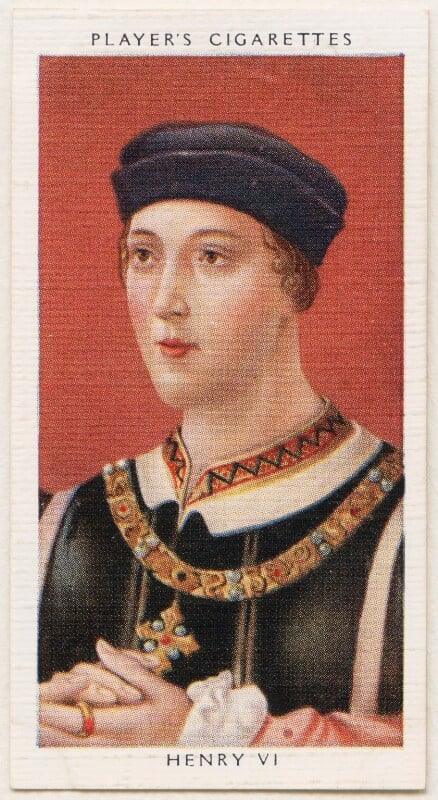
As with the vast majority of historical figures from the pre-Renaissance period, depictions of Henry VI in art from the time are lacking both in consistency and variety. The length of his reign–some forty years, which is a great deal longer than that of any of the kings preceding or immediately following him–might suggest that he would be blessed with more portraits than the average monarch from the Middle Ages; but unfortunately, this is not the case. In fact, the most recognisable image of him (shown below) was painted circa 1540, almost seventy years after his death:
This painting is likely a copy of an original from life, and has itself been copied many times in various forms, a significant one being Player’s cigarette cards…
…as well as this slightly unsettling copy in which Henry seems to be having a very bad day indeed:
A wide variety of other illustrations appear to use the 1540 portrait as a source, with the result that his appearance changes drastically from picture to picture–although, interestingly, almost all retain the characteristic clasped-hands pose:
This is only a small portion of the imitations of this portrait which can be found!
I’ve always been particularly drawn to this one due to the manner in which Henry is illustrated. He holds the privilege of being one of the very few medieval kings who is shown smiling in his portrait–perhaps for good reason, as it can hardly be denied that the impression given is not one which inspires awe or reverence. Personally, I am very fond of his slightly vacuous expression, but it nevertheless conveys an energy more appropriate for a saint than a warrior (a dichotomy I will discuss in a later post). He appears very kindly, with a childlike face (something which certainly has historical bearing); Desmond Seward’s ‘A Brief History of the Hundred Years War: The English in France, 1337-1453’ describes him as ‘a lanky, gangling, awkward youth with a pointed chin and mournful, worried eyes’, whilst the slightly dubious ‘Lancaster And York: The Wars of the Roses’ by Alison Weir depicts him as ‘a chubby-faced, clean-shaven youth’. Weir goes on to describe a portrait of him in later life, ‘with a far more angular and care-worn face’; I believe the portrait she is referring to is this one from the turn of the 17th century:
Intriguingly, this portrait too looks as though it was copied from the original: the pose is identical, as are the clothes and livery collar, though the face is much changed. He certainly appears far less childlike in this later portrait, though the ‘mild, saturnine air’ acknowledged by Piero da Monte in his 1437 visit to the fifteen-year-old king is still noticeable in the elder Henry’s physiognomy.
Upon Henry’s exhumation in 1910, it was discovered that he was 5’9″ inches tall, strongly built, with brown hair. These very basic indicators of Henry’s physical appearance are useful only so far as to confirm that his hair was, as shown in almost every portrait, brown; but beyond that, we still have about as much idea of what he looked like as did the artists drawing him in the 16th century. The same technology used to bring Richard III to life (not literally) could probably be similarly used in Henry’s case, as his skeleton is still buried at Windsor and is, as far as I am aware, fairly well-preserved; but I don’t believe this has ever been seriously suggested, and the response would likely be to allow him to continue to rest in peace.
The ultimate difficulty with navigating the issue of Henry’s physical appearance is that we are working from a copy of a painting from life which has since been lost. As can be seen from the earlier copies, his appearance changes dramatically with every reiteration, so there is no guarantee that the 1540 painting even resembles him in the slightest. In a future post I will discuss his depictions in illuminated manuscripts and other pieces from the period, which perhaps can shed more light on how he looked, or at least appeared, to his contemporaries.
Hello! Welcome to Friends of Henry VI. If you are viewing this then you are officially a Friend of Henry VI, which I hope he appreciates, wherever he is now.
I will be using this blog as a means to post a variety of Henry-related information, as well as my own opinions on issues and reviews of films and books in which he features. I will also cover relevant topics surrounding his life and rule, including key events of the Wars of the Roses, although the focus will largely remain on Henry’s involvement in these. If there is anything specific you would like to see discussed, leave a comment and I will follow it up.
Thank you very much for visiting, and for remembering this significant and oft-forgotten historical figure.




 Friends of Henry VI